07/04/2011

Getting airborne again


Of course, just jumping in an aircraft and heading off into the sky would be simple.  Well, it perhaps would be if my two yearly flight review was not due. So, I’ve started the process of making sure my Private Pilots Licence (PPL) is current and the trip can be completed legally. This started at Warnervale Airport and the Central Coast Aero Club with the commencement of my Biennial Flight Review. Following a break in flying, I can say it was a fantastic hour.
Cessna 172 - VH-BAO
Whether its a geek thing, I’m not sure, but flying light aircraft has it all. Lining up, increasing the engine speed and commencing a take-off roll from a standing start to a point where you can actually fly (yes, fly!) is truly exhilarating. Imagine a subtle start as the sound increases and movement begins to transform into a burst of energy.  The runway slowly turns from a textured surface into a blur of speed. Breaking from the ground at 55 knots turns this road going machine into an airborne craft that no only goes right and left, but up and down. Amazing.
As I look out the window I am not blessed with a sun-drenched vista. Today it is grey, but not a dull boring grey. Todays grey is full of a variable wind and rain, often heavy at times, making each take-off and landing different from the last. Any thoughts of work have long disappeared from my head – controlling a machine in flight and taking in the surroundings are filling my senses with an adrenaline fueled pleasure. But alas, good things come to an end and Andrew, my instructor, advises we make the next landing a full stop and the sixty minutes of flight (that feels like five) comes to an end.
I’ve still got a theory refresher and a some more flying to complete for my review, but if this is like todays adventure, I can’t wait.
I’m now hoping to finish my mission by the end of 2011 with the great folks at The Fred Hollows Foundation extending my fundraising permission until this date. So, if you haven’t already, please consider making a donation by clicking the ‘Donations’ button to the right of this page. 100% of donations go to the appeal. Thank you.

24/07/2008

NVFR


After several weeks practicing and reading up the skills associated with flying a light aircraft in the dark, Wednesday night was test time to demonstrate to the test officer that I could successfully pilot an aircraft in the dark alone.

Unlike driving a car an endorsement is required for a pilot to fly after dark and before dawn. This includes navigating by radio aids (as you cant see so many landmarks) and using instruments more to ensure the aircraft is not actually upside down or some other precarious position. Also avoiding low terrain is high on the list of things to get right.

After an oral theory test the flying got underway. The trip was supposed to be from Warnervale to Maitland, Singleton, Scone, Warkworth, Cessnock, Mt McQuoid to Warnervale. However a en-route diversion meant not getting as far as Scone. However the time saved in journey time was spent on demonstrating the recovery of unusual attitudes, navigation aides and orbiting 360 degrees whilst making sure my altitude did not vary by any more than 200 ft.

Two and a half hours later and the test was complete and I'm now happy to be able to fly at night.


24/01/2008

C150 Navigation Exercise

Some pictures from todays solo flight = Warnervale - Maitland - Bundook - Nowendoc - Quirindi - Scone (touch & go) - Singleton - Maitland - Warnervale. 4.5 hours. This picture taken just south of Scone.


This picture taken just south of Scone.

The hills and valleys of NSW.

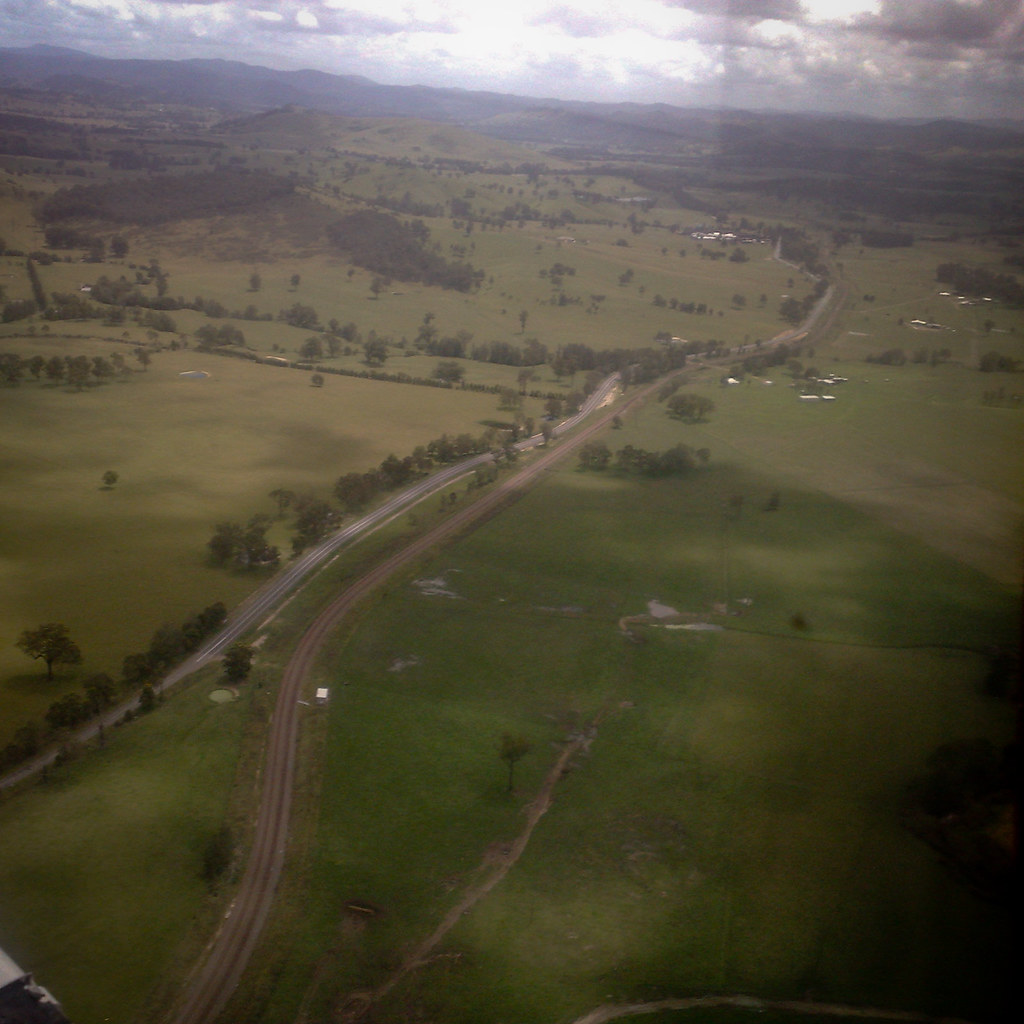
Following the railway line through the Williamtown military area.

To avoid being hit with a missile through the Williamtown military flying zone, its possible to fly up a 'lane' at 1000 feet which tracks the railway line. In this picture the railway and road run parallel. It was about at this point the aircraft radio stopped working....


06/01/2008

Overhead Sydney - 10,000 Feet


Overhead Sydney - 10,000 Feet
Originally uploaded by harrip.

Flew to Canbera and back today in a Cessna 172 (KHT) via Sydney controlled airspace. Awesome view - just like Google Earth :)

12/09/2007

Change of house, change of airfield

Having moved from Sydney to Terrigal, and got used to the mortgage payments, I finally got chance to pop along to my new local airfield at Warnervale to get some flying training under way.


Warnervale is almost the complete opposite of flying from Bankstown, my previous airfield. There is no control tower, there is only one rather narrow run-way, rather than than the three wide stips at Bankstown.


I've now signed up with the Central Coast Aero Club so I can continue to work closer towards my goal of obtaining a Commercial Pilots Licence (CPL).


My initial lesson was some basic familiarisation training and circuit revisision. As I'd not flown since May, I was a little rusty so it was good to get back in the air. I flew with Wayne Young, the CFI.

08/04/2006

Back seat to Tamworth

Yesterday I had a great trip to Tamworth with Danial and Brett - thanks for inviting me along guys. We left Sydney Bankstown at around 09:00 for Tamworth before returning via Port Marquirie arriving back at 18:50. Whilst I was just a passenger, I enjoyed the flight, tour of Tamworth (including the big guitar) experience in a Twin and the night flight.
Tamworth photos

31/01/2006

Weekend in Scone

Enroute to Scone

With a new aircraft type authorised in my log book and some training on the procedures at Bankstown, the time had finally come to put all this new knowledge to some use. A friend of mine, Dave, was driving from Sydney to Scone to see some relatives and I took the opportunity to fly up to meet him on Saturday, stay overnight before returning on Sunday. Billy was pleased to come along for the ride.

This was a virgin navigation flight for me in many ways. Id not headed north from Sydney in a light aircraft apart from as a passenger on one occasion. There are a few things to consider in particular The Lane. The lane is a strip of airspace between Williamstown military airspace and Sydney control zone. I had flown this a few times previously so all was good and my flight planning took this into consideration.

Saturday morning came and after getting a rather good weather forecast we headed off to Bankstown. I did delay the departure time until mid-day as there was supposed to be cloud and mist at Scone. Departure was delayed a little further whilst I got instruction on how to operate a new combined radio and GPS unit in SFK. Id not used such a unit before but after the instruction, found it intuitive to use and the GPS with a massive colour screen a good support fornavigation. At 12:30 we finally took off on runway 11C with the route being Bankstown, Prospect Reservoir, Parramatta, Brooklyn Bridge, Maitland and Scone. It was not the shortest route but did avoid the rougher terrain and associated rougher turbulence and the road network below helped with the navigation.

I happily got into the habit of changing fuel tanks on a regular basis a new requirement when flying a Warrior. The warning from my instructor that there are two types of pilot, those who have forgot to switch tanks and those that are going to probably helped to remind me. I choose to switch tanks every 15 minutes (on the hour, quarter and half past the hour) marking each switch on my flight plan and this worked well keeping the tanks even throughout the flight.

Whilst there were only a few clouds around and the mist had gone there was plenty of turbulence but good visibility. The airfield at Scone was easy to spot after I realised it wasnt the racetrack which is adjacent to it. With little wind around and no other traffic I had the best kind of landing an uneventful one. I then had to backtrack along the runway to the parking area on the east side of the field where I found a nice spot to park complete with tie downs. I was concerned I may be using someones parking spot but the phone call the day before did inform me to park on the easy side of the field.

Dave was waiting at the airfield and he picked us up to take us to the Motel. We then had some good food and a tour of the area before heading off met up with Daves relatives. We finally hit the sack at the Colonial Motor Inn which at $95 was a reasonable place to stay.

The motel had a socket I could plug my laptop in to get the weather. This was convenient and helped me complete my return flight plan conveniently. We then got breakfast in Scone and had a wander round before calling the Scone Taxi Service. Apparently there are just two cars with only one on duty at a time. It was around 11am and we were the drivers first call of the day. The trip from the centre of scone to the Airport took around 10 minutes at $12.

Thankfully the Warrior was still where we left it! I took the same route back which again was pretty uneventful apart from continued turbulence. An earlier start may have helped on that front. One thing of note was a general broadcast on the area frequency advising Williamstown control zone was going to become active for just 15 minutes whilst an aircraft flew in. My plan did not take me through here but it was worth knowing it can become active at such shortnotice and for such a short duration of time. The cloud was certainly getting lower and denser the further south we came but still fine for the necessary ground clearance.

Arrival at Bankstown was greeted with a change of runway. All my training and subsequent arrivals and departures had been on a 11 runway. This time the ATIS broadcast advised arrivals and departures were on runway 29. I remembered the procedure of continuing to the airfield at 1500 ft before descending to a circuit height of 1,000 ft once past the tower. This worked out fine and a reasonable landing followed. The taxi route to the flying club required that I held for clearance to cross an active but this was soon given and we were parked up in no time.

All in all I enjoyed the weekend very much. Im now looking forward to more cross country flights around NSW and hopefully beyond.


21/01/2006

Bankstown and the Warrior - Part 3

At thirty three degrees, today was another hot one for flying. Leaving the air conditioned club house was not easy when welcomed by the heat and humidity at the airfield. Nonetheless, after completing the pre-flight and being joined by Danial, the engine started and the breeze from the propellar finally clicked in.
Today's aircraft - FTU

This was the final part of my Bankstown and Warrior familiarisation training and what fun I had! In addition to practicing a engine failure on take off, an engine failure in the circuit requiring a glide approach a go around and a normal landing, I was signed off to go solo on the new aircraft type and the airfield.

Danial left the aircraft (whilst on the ground!) and off I went. First a standard circuit before departing into the local area and back to Prospect Reservoir before making my way back to the airfield. Most my training and flying to date have been in Cessna aircraft but I'm now pleased to add another type to my log book. In addition to making another aircraft type available, they are a nice aircraft to fly.


14/01/2006

Warrier and Bankstown familiarisation continues

Another Saturday afternoon and another flying lesson. This time continuing my familiarisation of the Warrier and Bankstown airport. With Danial running a bit late the lesson was for spot on an hour, but with temperatures and humidity soaring, it wasnt a problem!
We started off flying from Bankstown into the local training area. After climbing to 3,000ft it was still pretty bumpy due to turbulance so decided against stall practice. Instead, I had to practice an engine failure, thankfully making it to the nominated field before taking off again heading to Hoxton Park where I did a touch and go.

To finish off we headed back to Prospect Reservoir to get permission to land again at Bankstown. Landing on the centre runway this time it was soon back to the club house where chilled drinks were the order of the day!


Hoxton Park

07/01/2006

Bankstown and the Warrior

After a couple of months break whilst I got the final theory subjects for my CPL under my belt I was very glad to get back in the air with my instructor to learn the ins and outs of operating from Bankstown, one of Australia’s busiest General Aviation airfields, and a new aircraft type, the Warrior.


The move came as I felt ready to get experience at a busier airport and also to continue to make use of my excellent instructor who recently moved flying schools. The airport is about 40 minutes nearer than Camden, my previous flying home, so quicker to get to.
Whilst I thought I only had an hours flying lesson booked, the actual introduction took most the afternoon, arriving for 2pm and not leaving before 7pm. After a tour of the fleet at the Scholfield Flying Club it was inside for some ground school on the various procedures at Bankstown. This covered radio, arrival and departure procedures and a look at the map on how to taxi to one of the three runway strips.

If anyone reading this is looking for more information on flying from Bankstown or any of the main Sydney airports, take a look at the excellent Sydney Basin Visual Pilot Guide. The main points to note are:

- Different arrival and departure altitudes depending upon the active runway.
- The southern runway is typically used for circuit training and is on frequency 123.6
- Centre and northern runways are typically used for arrivals and departures on 132.8
- Approach points of 2CN in the south and Prospect Reservoir in the north
- Care not to intrude on the joining Sydney International class C airspace.

At the same time as looking to find my way around Bankstown airport was the interesting learning of a new aircraft, the Piper Alpha Warrior. Having nearly always trained and flown Cessna's I was rather daunted by this challenge. However, once I had a detailed brief from Daniel and started the plane up, I started to feel at home with Sierra Foxtrot Romeo (SFR).
Checking the aircraft was quite similar to the Cessna. Perhaps the most alarming difference though was finding water in the fuel. I was however assured this is quite normal for aircraft that stand outside frequently such as this one. Nonetheless, a first for me and I was relieved when the second fuel test revealed just fuel.

The main control differences between the Warrior and the Cessna I noted are:
- No ignition key. Just switches for power, alternator and mags. Switches to remain switched on during flight have a nice little guard around them.
- Two fuel tanks and no duel feed option - i.e. you must select left or right tank - and remember to interchange them!
- Fuel pump has to be used at critical stages of flight. Switch it on at the run-up bay and turn off at 500ft. Turn on when performing downwind checks prior to landing and off when exiting the runway.
- Flaps are operated by a 'handbrake' style leaver rather than electric. They can stick in the down position too until some wind resistance forces them up.
- Carb heat is present as there is no fuel injection.
- Nice reminder for shutdown - Lights, Camera (radio), Action (Mixture).

In flight the aircraft was quite comparable to the Cessna to fly and probably a touch easier to land. Hopefully I will be signed off after just one more lesson.


02/11/2005

Passed!

After various delays, including a trip to the UK, I finally got the chance to resit the final theory exam I had left to sit for the Commercial Pilots Licence - CPL Performance. I had hoped to sit it on 21 September, but a month and a bit later finally got the chance to make the trip to the exam centre.

I arrived at Bankstown at around AM and after getting the bottle of water and Mars continued to the assessment centre. One hundred and fifty minutes later, I clicked submit on the on line testing system to be greeted with "Pass"!

This exam was certainly the most difficult of the lot, and I'm pleased I left it until the end else I may have been put off continuing had I started with such a difficult subject.
The difficulty came down to having to learn a number of formula's, in particular for weight and balance calculations and for understanding Points of No Return and Equi Time Points. Scary stuff! Learning the names of clouds seems easy in comparison. The test included 30 questions on:

- Density and Pressure Height- Take-off and landing performance- Climb cruise and decent performance- Loading- Flight planning- Airworthiness and equipment- Calculating equi time points and points of no return

With the theory out of the way, I'm now looking forward to the flying the 44 hours I need to complete before I can take the practical flying test. Should be a fun summer!

03/09/2005

Camden - Mittagong - Goulburn (and back again)

Today I decided to give my navigation skills a bit more of a test than can occur from the Sydney Scenic flight which I've been doing quite a lot of recently. Instead, I headed south to Goulburn.
I had the aircraft booked from 12:00 until 14:30 but with no bookings prior to mine, I decided to turn up a bit early to see if we could head offer a little earlier.

After checking the plane out, learning it had quieter gyro's installed (hence the missing whirring noise when you click the master switch) I had no concerns in using Y-SCN one of the two Cessna 172's I had used during my training.


With Billy as my passenger - clinging to my old GPS unit and his vintage 110 camera, we started up, got the traffic information and headed off for runway 06 and took off at about 11:55.
As it was a weekend the tower was manned. This certainly helps from compared to the unmanned tower during the week as it was reasonably busy with a few aircraft in the circuits. But today was not for circuits, it was for heading off south, firstly via The Oaks, then Mittagong before reaching Goulburn.

The navigation worked out well. Most places appeared on the nose as they should have, but with the Hume Highway going from one side to the other most of the time its not the most difficult navigation exercise. Billy had the GPS unit too which provided a little reassurance but I was determined not to let it become a primary navigation aide, preferring my map and getting used to using NDB's again.

I think I surprised Billy by actually landing at Goulburn, I think he thought we were just going to head back. I was however, pleased to get the practice landing away. There were a few aircraft in the circuit at Goulburn and with limited taxi ways it makes it interesting for anyone wanting to land and do a full stop. We landed fine, and then had to 'backtrack' along the runway to the parking area. This occurred just as another aircraft was going to land and take off again (touch and go) so with us having right of way he had to go around without landing.

After parking up we managed to find a fridge and some cans of drink to refresh ourselves. At a $1 a can it was a bargain. We then took a look round the airport building which apart from a few new hangers, certainly look antique to say the least.

A small jet aircraft was also flying out of Goulburn and came in to land shortly after us. It had its own Shell tanker stood by ready to fill it up. The pilot also seemed to have his own fan club with about 10 onlookers greeting him like a celebrity (maybe he was!).

After dipping the tanks, checking the oil we headed off again, but not before the jet pilot kindly told me I had a strap hanging out the cargo hold - thank you! By the time it came to take off, the wind had changed to a cross wind and I waited to see what happened with the another aircraft that landed about the same time as us. Would they use the main runway or the shorter one? They used the main runway and took off fine. I used the main runway and the cross wind did catch me a bit unaware taking me across the runway a bit but we took off okay.

On the way back the navigation was again as it should be - uneventful. Places appeared on the nose, although there was a bit of drift this time. The air was smooth which was evidenced by Billy falling asleep during this part of the flight :)

We got back to Camden at around 14:40 so it was as well we left that bit earlier enabling us to have the stop at Goulburn. I was the only traffic in the circuit at Camden on my return and carried out a good landing.

After doing the paperwork I headed off home content that I could remember how to navigate beyond Sydney and am now looking further to getting further afield.

30/07/2005

Victor 1 with twiddly bits

For a treat for my brother and nephew who are currently in Australia, I offered to take them for a scenic flight over Sydney. Whilst I've done the scenic flight a few times before now, I decided to have a go at doing the optional orbits over the harbour. I've been reluctant in the past as it involves a bit more radio work as you have to get permission from the guys at Sydney International Airport to be able to do this.


Anyway, whilst the radio was certainly busy, I managed the calls okay and even got back to Camden before dark. I later learnt that my flying instructor was in one of the other planes flying around the harbour. It was perhaps as well I didnt know this was the case until after the flight!


15/07/2005

Back in the air, just...


After a month in the UK, and finally having a few cents in my pocket I managed to reach to the skies again to fly a few circuits.

Today there was a bit more wind than the last time I flew, which actually helped on the landings. On my previous flight, the wind was 'light and variable' and I was cought out on one circuit with a clight tail wind. With a few knots of headwind today, and a slight cross wind at times, it lead to some better circuit practice.

Take-off was delayed a bit though through a faulty aircraft. On switching on the Masters to lower the flaps prior to my pre-flight inspection the usual whir of the Gyro's was not present. A phone call to the engineer soon sorted this. I'm pleased I noticed the problem as the flight could certainly have been a bit too interesting with only some of the flight instrucments working!
The flying school has now added a new online booking system to its website which makes booking even easier - its just like booking a flight online with Virgin Blue :)

13/01/2005

Round and round we go...

After obtaining my Australian Private Pilots Licence in October last year I have been remarkably lapse in not flying for the last month or so. Yesterday I decided to put this wrong right and drove off to my flying school at Camden.

It was hot, 37 degrees according to the Australian Bureau of Meteorology. Kneeling on the tarmac to check the fuel of the Cessna confirmed this as I swiftly got a rag to kneel on to save burning my knees.

Anyhow, after fueling the aircraft and checking it out (and remembering how to start it) I taxed off to runway 04. After the pre-takeoff checks I took off and headed into the local area before rejoining and practicing my circuits with five take off and landings. I was pleased that I had not forgot how to land the plane!

After flying on such a great day, albeit a bit on the hot side, I can't wait to get in the cockpit again soon. I'm hopefully taking two friends up on Sunday and doing a flight along the Sydney coast line - I hope the weather holds!


17/11/2004

Flying Victor 1


I've just got my hands on some photos my first Australian passenger, Billy, took whilst I flew Victor 1 in Sydney a week ago. Victor 1 runs along Sydney's coastline, ducking under the approach path for Sydney's East-West runway. Its compulsory to fly at 500 feet for much of the route.

The picture below is a taster, more here.

18/10/2004

PPL for the second time

I first obtained a PPL in 1997 but after starting up my own business, flying sadly fell by the wayside. 6 years later with a few pennies in my pocket and whilst currently living and working in Sydney, Australia I decided to see if I could get flying again.

In June I started the process. As I already had a UK PPL to convert to an Australian licence I just had to pass an Australian Air Law exam and pass the Australian PPL flight test.

The Air Law exam was not too bad, similar in many aspects to the UK version although it is a Cyber exam (done online at the flying school) and surprisingly open book. Being open book did not make things much easier though as there are so many Australian aviation related manuals to take into the exam and finding the right content can take some time.

I took and passed the PPL flight test last Monday. This involved flying from my home airfield (Camden, south west of Sydney) to Canberra International. This first leg was a navigation exercise to prove I could find the destination and handle class c airspace. Unlike today, it was fabulous weather although this was after about 5 cancellations due to poor weather. Its not all sunshine in Sydney! In fact it can get very wet but more often, very windy.

The return trip from Sydney to Camden was via a small private strip at a place called Crookwell. Here I had to demonstrate stalls and a precautionary landing and various other handling skills before proving I could find my way back to the home airfield. 3.3 hours later I was back on the ground and informed of my pass. Yay!!

After roughly 6 years non flying I was very rusty, but my flying school did a fantastic job in getting me back up to speed with all things aviation whether getting to grips with Australian procedures or hands on flying training.

If anyone is in this neck of the woods, they could do far worse than get in touch with the guys at http://www.airborne-aviation.com.au . I found it a total pleasure getting back in the left hand seat. I avoided weekend lessons opting for weekday slots. This resulted in unrushed lessons with an excellent instructor. I can confidently say its one of the best flying schools I've been to and I'm not getting paid to say it

I feel as though all the various components of getting a PPL have been put in context and I am now comfortable and looking forward to exploring more of this great land... once the PPL has actually arrived that is!